I wanted to look into another area of when fashion/art has been used to unify people, and I’ve decided to look specifically at Northern Ireland. I’ve already looked into the Punk scene during the Troubles and how people used fashion to claim a new identity, and now I want to look into another very important civil rights movement, the women’s rights movement of Northern Ireland.
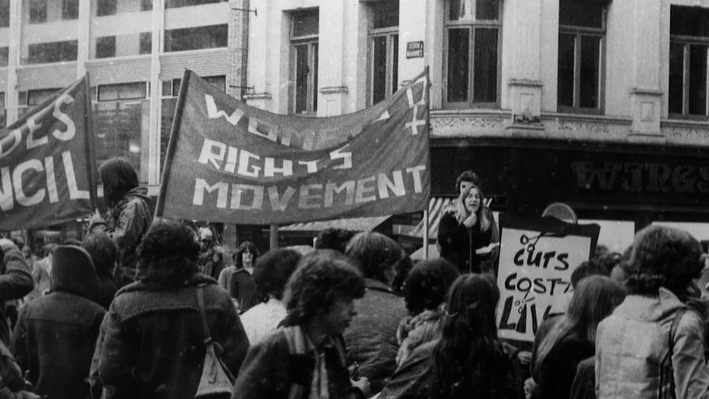
As I’ve come to realise, most aspects of life in N.I. have been affected by the conflict we experienced over the years, and the progress of women’s rights is no different. I used to wonder if the reason N.I. is considered by many so ‘old-fashioned’ in terms of it’s laws and social issues was because of or at least heavily impacted by the Troubles, and as this project continues, I’m starting to realise it undoubtably is. This is why I want to focus my project, because although the issues I plan to address are definitely an issue all across the UK and rest of the world, the people of Northern Ireland have arguably been in worse situations when it comes to trying to move forward culturally, because of things like the conflict, and the strong religious bias of those in power.
The women’s movement in N.I. came around the same time as everywhere else, with the second wave of feminism, and the wider civil-rights movement of the late 60s. It was largely affected by the other social issues at that time, and because of this, the existing differences with many things were made more obvious and had more emotion tied to them.
“Although women had come together before on occasion to protest (for example, against the ending of free school milk for children) or to focus attention on the issue of domestic violence, the year 1975 saw the formation of the first organized group, the Northern Ireland Women’s Rights Movement (NIWRM). This group aimed “to spread a consciousness of women’s oppression and mobilize the greatest possible numbers of women on feminist issues” (NIWRM Manifesto 1974). They called specifically for the extension of Britain’s Sexual Discrimination Act to Northern Ireland.”
With such a broad range of political/social views within the group, tensions ran high, and many accusations were made, which arguably hindered the progress made, along with divided attentions between women’s rights and other issues of the time. Many women had become politicised because of immediate experience, such as wives of interned men, and so many battled not only men, but institutions of state. The NIWRM claimed to be unaligned, although it faced much backlash, and many claimed they were neglecting targeting the state.
“Support for women political prisoners, all of whom were republican, was a particularly emotive and divisive issue. Those who aimed to combine their commitment to socialism with feminist and nationalist concerns formed the Socialist Women’s Group in 1975; it dissolved two years later, and many members reunited in the Belfast Women’s Collective. Women against Imperialism and the Relatives’ Action Committee provided forums for campaigns more closely linked with the rights of political prisoners. During the 1980s they were heavily involved in support of women prisoners in Armagh jail who went on hunger strike, took part in a “no wash” protest, and were frequently subjected to strip-searching. But with the NIWRM refusing to engage in the protests, “Armagh became a metaphor for what divided women here from each other” (Ward 1991, p. 156).”
Although the women of N.I. had their struggles, undeniable progress was made over the years. “An Equal Pay Act was passed in 1970 and a Sex Discrimination Act in 1976. The setting up of the Equal Opportunities Commission in the same year was seen as particularly helpful by those feminists and trade unionists for whom the right of women to work, and to be given equal opportunities and rewards, were considered fundamental entitlements. The establishment of women’s aid refuges, rape crisis centers, and well-women clinics can also be attributed to feminist lobbying.”
“Perhaps one of the most distinctive and important developments in Northern Ireland, however, was the growth of local women’s groups. Coming together for solidarity and mutual aid in their strife-torn communities, women learned from and built upon their own experience. Through consciousness-raising classes and educational courses in women’s history, literature, and place in society, women in many areas became both more politicized and more experienced in dealing with local problems. During the 1980s and 1990s a series of meetings and conferences highlighted women’s issues and sought ways to facilitate their inclusion in the political process. As a result, many women became more active in a range of political parties, and in April 1996 the Northern Ireland’s Women’s Coalition was formed and succeeded in winning two seats in the newly established Northern Ireland Forum. The party sought to bring a new gender perspective to national politics with the key principles of “inclusion, equality and human rights” (Fearon 1999, p. 13).”
So although there was no massively obvious autonomous movement, due to the countries deep divide, the small groups of women managed to bring around an arguably more fundamental change, which continues to this day.
Source:
 time to change