I’ve read a really good journal on the journey for women’s right in Northern Ireland, which explains more in depth how it differed for women there compared to other countries, due to the economy, conflict, religious views etc of the time. Here are some quotes/information I think may be useful to me in writing my dissertation:
“They share the familiar problems of women in other industrialised countries, perhaps experiencing more acutely than others the effects of economic recession. At the same time, they live in an environment which is more influenced by male beliefs and values than is the case for other industrialised countries. Traditional religious beliefs hold sway in the communities, and form a background against which violent social conflict is waged.”
“This conflict, and the secretarian polarisation of Catholic and Protestant communities which is both cause and result of it, has had unpleasant consequences for women individually and as a social group… Divisions among feminists over politics and ideology are a recurrent feature of all modern women’s movements; in Northern Ireland, the familiar socialist/revolutionary feminist camps are fragmented even further by differences over Republicanism and the IRA campaign.”
The second wave of feminism in the 60s seemed to have missed Northern Ireland, as although a few individuals reported their support, no obvious organisations were formed.
“The ideas were circulating for some time before and organised response emerged. This pause might be related to the rather peripheral status of Northern Ireland within the United Kingdom, which was underlined in the lates 1960s by the existence of the devolved Parliament at Stormont.”
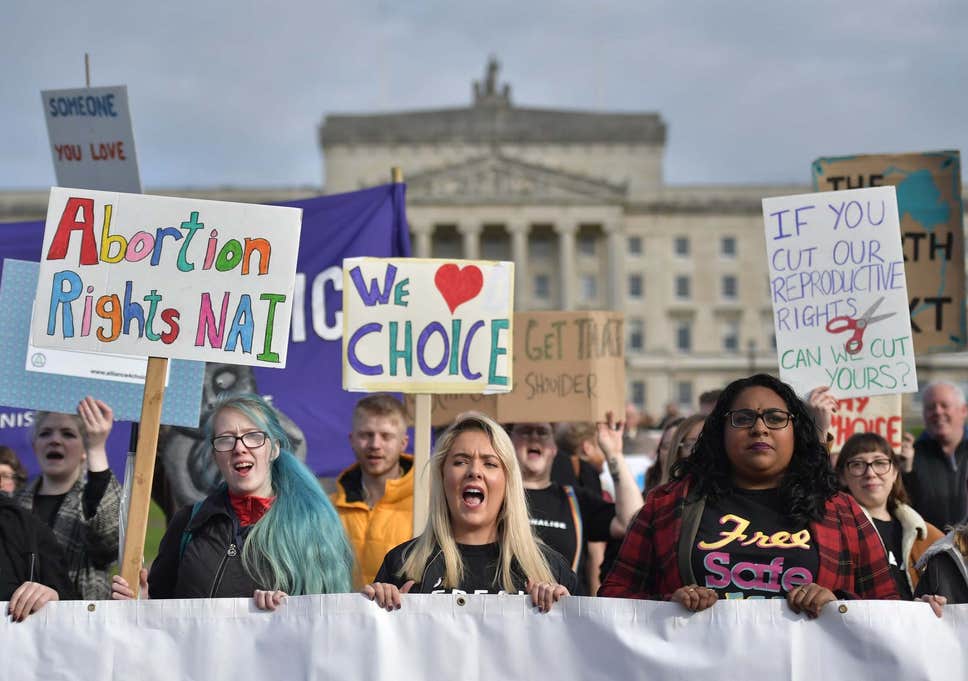
“The legal status of women in Northern Ireland was in some respects worse than that of women in Great Britain. The Northern Ireland Parliament at Stormont had autonomy in domestic matters and, dominated as it was by men of strong religious convictions, it would on occasions refuse to introduce reforms which might offend religious sensibilities.”
“The 1967 Abortion Act was rejected, as was a measure aimed at making divorce easier to obtain.”
The early 70s, along with the renewed violence of the IRA, brought a more active involvement by women in a number of areas. Poverty and poor housing saw women campaigning not only on behalf of women, but for the community as a whole, and some groups started to form.
“The first group of women formed was based in a working class community, Belfasts Ormeau Road. This group campaigned against poor housing conditions in the area and against the poverty suffered by its inhabitants, using direct action and lobbying with some success (Belfrage, 1987).”
“In 1974, a “consciousness-raising” group appeared int he small town of Coleraine, involving women from the New University of Ulster and from the town itself. The Coleraine Women’s Group quickly became a campaigning as well as discussion group, focusing public attention on the existence of domestic violence against women nd on the related issue of the problems of single-parent families (Ward 1987, 61).”
The disagreements between women in these groups was inevitable, and frequent. For example, in the NIWRM, the first disputes came from whether men should be allowed at all to attend meetings.
“The fact that the membership of an constituency for women’s groups in Northern Ireland is relatively small may make unity more necessary, but has been no guarantee of it being a reality.”
“The NIWRM, like other groups, discussed the general political situation in Northern Ireland. There was a wide variety of political opinions held by it’s members, including variants of left-republicanism/nationalism. The movement decided, and this decision was reaffirmed on a number of occasions, that it would not adopt a political position on Northern Irelands constitutional future. The aim of the movement which had priority over all other considerations was to unite women from all political traditions or none in order to campaign in all ways possible for women’s rights at work, in the home and in the community.”
“The prison protest and hunger strike affected everyone in Northern Ireland, of course. It became an issue of particular importance for women’s groups because of the involvement of some feminists with the Relatives Action Campaign and because some IRA women prisoners joined the protest… Publicity for the women’s protest was achieved through the efforts of a group called Women Against Imperialism.”
The NIWRM didn’t divide over the issue, but instead chose to remain unbiased and target how women are treated in prison.
“Using “Orders-in-Council,” the Labour governments of 1974-79 extended various pieces of legislation to Northern Ireland. The Equal Pay and Sex Discrimination Acts were introduced, as were Employemnet Protection Laws which benefits part-time workers, of whom many were women. An Equal Opportunities Commission for Northern Ireland was set up and Northern Ireland’s divorce laws were improved. The Conservative government in 1980 introduced the Domestics Proceedings Order, which gave some protection to victims of domestic violence.”
“The advances made in women’s rights and status achieved by 1979/80 had been fought for by a relatively small number of women. Only a few hundred women were in any way involved in feminist politics or in women’s groups.”
“The attempt to create a broad women’s movement in Northern Ireland has proved, inevitably, to be extremely difficult. While it has been possible to draw in women from different religious and political traditions and to win support from both middle-class and working-class women, women’s groups have not been able to avoid dividing over political issues.”
The divide of the polarised community, although improved slightly from the time this journal had been written, needs a massive amount of improvement. It’s clear to me that with any social/cultural issue, such as feminism/women’s rights, but also any form of equality, will be hindered if we cannot band together. This reaffirms my context of practice when it comes to my practical, as if I can use fashion/art to unify people (as in my essay question), surely it can only be a good thing in bringing Northern Ireland into this century in terms of it’s political/social state.
Source:
 time to change