Notes on an article talking about the rise in protest dressing:
“When the women of the US Democratic party dressed in unanimous white at President Donald Trump’s recent State of the Union speech, they made a powerful statement that the status quo in Washington will be challenged.
Representative Alexandria Ocasio-Cortez explained that they wanted the president to see “a wave of white” – a colour which historically has associations with the Suffrage movement and was worn by Hillary Clinton during her presidential campaign.”
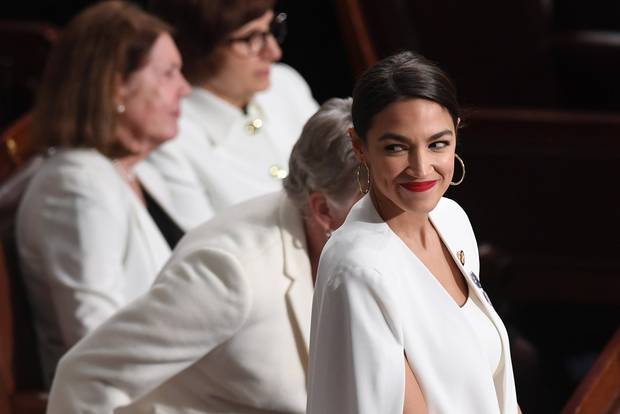
“The tradition of protest dressing isn’t new, but it has been revived dramatically of late, with incarnations including the appearance of women dressed as Margaret Atwood-inspired Handmaids in Washington to protest Brett Kavanaugh’s appointment, the “Pussy” hats adopted by thousands of women on marches after Trump’s election, and the wearing of black on the red carpet at the 2018 Golden Globes for the Time’s Up campaign.”
“Social and political tensions globally have re-asserted the role of fashion as a vehicle for protest. Scandals and discord in institutions such as Hollywood, the Catholic Church, the US government and the Brexit-stricken UK House of Commons have shaken beliefs and provoked a visible reaction, particularly from women. Now choosing what to wear is no longer simply about style.”
Fashion is quickly becoming the modern day go-to tool for reaching a global audience to make a statement and challenge the way things are.
“Even what you don’t wear can be a protest – recall Pussy Riot’s use of nudity to protest Putin, the Supermodels’ PETA poster where they posed nude with the slogan: “We’d rather go naked than wear fur” and the ’70s socialite, who on being refused entrance to the conservative Côte Basque in New York (because she was wearing a Le Smoking trouser suit), simply removed the trousers and wore her jacket as a mini dress, in an example of sophisticated subversion.“
NOTE: Look up more of Pussy Riot.
“One of the most striking images of the 1980s was that of Katharine Hamnett wearing her infamous ‘58% Don’t Want Pershing’ T-shirt to Downing Street, to confront Margaret Thatcher. Hamnett has revived her slogan T-shirts successfully with her ‘Cancel Brexit’ version particularly topical. Other slogans from the designer include, ‘Fashion Hates Brexit’, ‘Second Referendum Now’ and ‘Vote Trump Out’ (which is currently sold out).”
It seems you can now get away with being shocking and blunt with the messages on your tees, because the audience for this sort of fashion is growing by the second. However I don’t see many people in places like Northern Ireland wearing tees declaring such daring messages, perhaps because of the religious views and fear or judgement. I also believe designers just aren’t producing these sorts of garments, likely because of lack of demand (we all gotta eat, right?) but maybe someone needs to encourage such behaviour to begin with, in order to get the ball rolling? Perhaps in the form of a zine?

“Vivienne Westwood has been a strong advocate for climate change protest for decades and her recent London Fashion Week show featured Rose McGowan – a driver of the #MeToo movement since making allegations against producer Harvey Weinstein – delivering a speech on consumerism, models wearing T-shirts that berated politicians and bags sporting the statement ‘I Heart Crap’. “
“Fashion feeds off an innate collective intelligence and will always reflect what women are experiencing in their lives. Coco Chanel vividly expressed this relationship between fashion and life: “Fashion is not something that exists in dresses only; fashion is something in the air. It’s the wind that blows in the new fashion: you smell it. Fashion is in the sky, in the street, fashion has to do with ideas, the way we live, what is happening”.”
“Clothing can comment on social and political issues and is an accessible tool for women to engage in debate or protest in an immediate way.”
Source:
 time to change