Sumptuary Laws:
- Laws regulating permitted consumptions, especially in relation to clothing/fabrics
- Easy way to identify social rank and privilege
- Means of preventing commoners from imitating the appearance of aristocrats
- Means for the nobility to cap the conspicuous consumption of the prosperous bourgeoisie of medieval cities
Simmel:
- Trickle down theory
- Emulation
- Distinction
- The ‘Mask’ of Fashion
‘Fashions are always class fashions, by the fact that the fashions of the higher strata of society distinguish themselves from those of the lower strata, and are abandoned by the former at the moment when the latter begin to appropriate them’
(Simmel, in Frisby, D. and Featherstone, M. 1997, pages 187-217)
‘Clothes were a tool of oppression, a weapon wielded against the poor. They were used to drive home the lesson that the grand were not simply different, they were better, because they were rich. They wore on their backs the proof that they were superior intellectually, morally and socially’
(McDowell, 1984:10, in Craik, 1993, page xi)
‘The designer-artists who initiate fashion intuit somehow the currents of identity instability pervading a people and seek through the artful manipulation of the conventional visual and tactile symbols of clothing presentation to lend expression to them, or alternatively to contain, deflect, or sublimate them. To do so is necessarily to alter the clothing code in one or another way so that at some level of consciousness, if only subliminally, new, psychologically satisfying reflexivities can be evoked from potential wearers of the fashion’
(Davis, 1992, page 17)
‘When fashion sticks it metaphorical gilt frame around a leather motorbike jacket, a hippy kaftan, a pair of trainers or a raga girl’s batty-riders , it transforms an emblem of subcultural identity into something which anyone with enough money can acquire and wear with pride’
(Polhemus, 1994, page 8)
‘Marx’s conception of communism was not primarily that of a particular type of political party, let alone a state, but of a society without class antagonisms , without classes: “an association in which the free development of each is the condition of the free development of all,” as the Communist Manifesto puts it’
(Osbourne, 2005, page 73)
‘What Marx understood as communism would abolish private property – it would be a system of common ownership of the means of production – but it would not regress behind the enormous historical advance for the species represented by capitalism’
(Osbourne, 2005, page 80)

‘The uniform, then, is a radical form of clothing that is employed to announce a particular type of identity that acts both as shorthand of the kind of behaviour exhibited by the wearer and expected by the observer’
Craik, 2005, page 5
‘Uniforms are ambiguous masks of appearance, on the one hand, intending to unambiguously place the attributes and role of the person, yet, on the other, part of complex social play that can be deliberately appropriated, subverted or rejected’
Craik, 2005, page 6

‘Visibility is one of the distinctive features of subcultures, hence members aim to create an instantly recognizable appearance so that both fellow travellers and non-members can identify who they are and are not. In short, in creating a distinctive look, subcultures create quasi uniforms, sometimes with secret codes for other members’
Craik, 2005, page 193

‘Subcultures institute quasi-uniforms as strict codes of adherence as the hallmark of their resistance or opposition to the mainstream culture. In fact, the more radical the subculture, the more cohesive the subcultural codes of dress, behaviour and beliefs’
Craik, 2005, page 194

‘Uniforms (formal and informal) are thus strategically used to play the games of social life by allowing people to conform to groups they are part of (school friends, relatives, religious groups, ethnic groups, occupational categories and so on) as well as moments in rites of passage (playmates, teenage rebels, romance seekers, homemakers, parents and retired people). In other words, people use dressing as a game in which to maximize the fit with one’s peers and, equally, let spectators know “what game they are watching”’
Craik, 2005, pages 5 – 6
‘It is essential that the wearer and onlooker share a common code about the meaning of the item and how to wear it in order that a tie – or indeed – any piece of uniform can “work” as a social marker’
Craik, 2005, page 8
‘Attempts to be subversive depend on a precise knowledge and tacit acceptance of the rules and also of what extent deviations will be tolerated’
Craik, 2005, pages 12
‘In other words, there is a constant play between the intended symbolism of uniforms (sameness, unity, regulation, hierarchy, status and roles) and the informal codes of wearing and denoting uniforms (subversion, individual interpretation and difference)’
Craik, 2005, page 7
‘ “Identity” is a hopelessly ambiguous idea and a double-edged sword. It may be a war-cry of individuals, or of the communities that wish to be imagined by them. At one time the edge of identity is turned against “collective pressures” by individuals who resent conformity and hold dear their own ways of living (which “the group” would decry as prejudices) and their own ways of living (which “the group” would condemn as cases of “deviation” or “silliness”, but at any rate of abnormality, needing to be cured or punished’
Bauman (2004), Identity, page 76
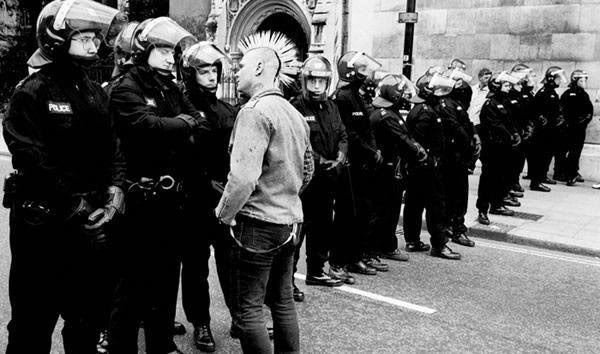
I think it’s pretty cool that fashion/clothing used to be a tool of oppression, used to immediately identify someone’s wealth or status, and therefore allow someone to be judged accordingly. Nowadays, although the immediate judgement is arguably still there, fashion is used as a form of expression. Instead of our identities being forced upon us by what we have to wear, we get to choose our identity and tell the world who we are through what we wear. Fashion is now also being used for perhaps nearly the opposite of oppression, to send a message, and fight against what we believe to be wrong. The punk movement couldn’t be a better example of this. Taking the connotations of the word uniform (boring, lacking individuality, oppressive) and making it into a uniform of rage, creativity and power. They used what they wore to shock people and express the anger they felt at how the world around them was. They used the uniform of punk to give themselves a new identity. In terms of Northern Ireland, they were no longer automatically Protestant or Catholic, they chose to identify as punk.
 time to change