Notes/summary of 1st year Identity lecture (I picked out the information that is useful to me and what I’m looking at for my module this year):
Historical phases of identity:
Douglas Kellner – Media Culture: Cultural Studies, Identity and Politics between the Modern and the Postmodern, 1992
- Pre modern identity – personal identity is stable – defined by long standing roles
- Institutions determined identity
- Marriage, The Church, monarchy, Government, the State, Work
- Modern identity: 19th and early 20th centuries
- Modern societies begin to offer a wider range of social roles. Possibility to start ‘choosing’ your identity, rather than simply being born into it. People start to ‘worry’ about who they are.
- Georg Simmel: ‘The feeling of isolation is rarely as decisive and intense when one actually finds oneself physically alone, as when one is a stranger without relations, among many physically close persons, at a party, on the train, or in the traffic of a large city’
- Simmel suggests that because of the speed and mutability of themselves to find peace. He describes this as ‘the separation of the subjective from the objective life’
- Post-modern identity – accepts a ‘fragmented ‘self’. Identity is constructed.
- ‘Discourse analysis’ – Identity is constructed out of the discourses culturally available to us.
- What is a discourse ? ‘… a set of recurring statements that define a particular cultural ‘object’ (e.g., madness, criminality, sexuality) and provide concepts and terms through which such an object can be studied and discussed.’ Cavallaro, (2001)
- Age
- Class
- Gender
- Nationality
- Race/ethnicity
- Sexual orientation
- Education
- Income
- Etc
Class: ‘“Society” …reminds one of a particularly shrewd, cunning and pokerfaced player in the game of life, cheating if given a chance, flouting rules whenever possible’ Bauman (2004), Identity, page 52.
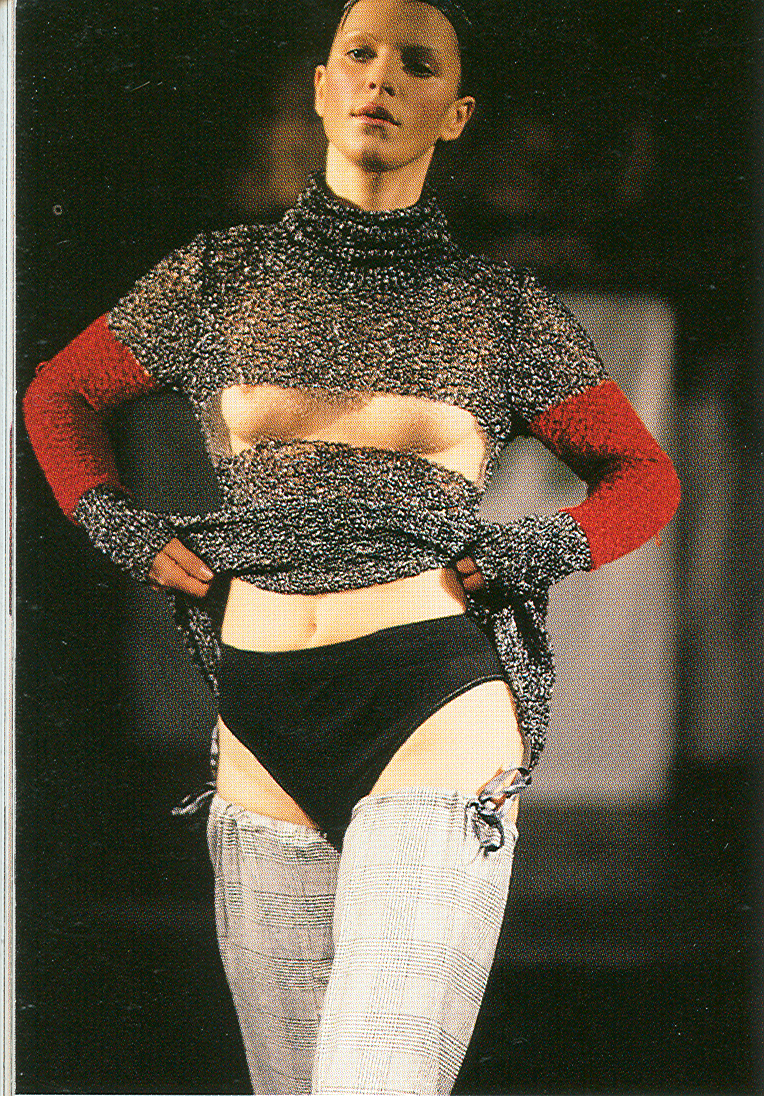
Nationality: ‘Much of the press coverage centred around accusations of misogyny because of the imagery of semi-naked, staggering and brutalized women, in conjunction with the word “rape” in the title. But McQueen claimed that the rape was of Scotland, not the individual models, as the theme of the show was the Jacobite rebellion’.
Evans, C. ‘Desire and Dread: Alexander McQueen and the Contemporary Femme Fatale’ in Entwistle, J. and Wilson, M., (2001), Body Dressing, Oxford, Berg, page 202.

Race/ethnicity: ‘Hair has been a big issue throughout my life… It often felt that I was nothing more than my hair in other peoples’ eyes’
Emily Bates, Textile Designer/Artist
Post modern theory
- Identity is constructed through our social experience.
- Erving Goffman The Presentation of Self in Everyday Life (1959)
- Goffman saw life as ‘theatre’, made up of ‘encounters’ and ‘performances’
- For Goffman the self is a series of facades
Zygmunt Bauman: ‘Yes, indeed, “identity” is revealed to us only as something to be invented rather than discovered; as a target of an effort, “an objective”’
‘We use art, architecture, literature, and the rest, and advertising as well, to shield ourselves, in advance of experience, from the stark and plain reality in which we are fated to live’.
Theodore Levitt, The Morality (?) of Advertising,1970
Rene Descartes (1596 – 1650), Enlightenment Philosopher:‘I think therefore I am’ (Discourse on Method, 1637)
In conclusion:
‘“Identity” is a hopelessly ambiguous idea and a double-edged sword. It may be a war-cry of individuals, or of the communities that wish to be imagined by them. At one time the edge of identity is turned against “collective pressures” by individuals who resent conformity and hold dear their own ways of living (which “the group” would decry as prejudices) and their own ways of living (which “the group” would condemn as cases of “deviation” or “silliness”, but at any rate of abnormality, needing to be cured or punished’Bauman (2004), Identity, page 76.
I found it strange re-reading this lecture with Northern Ireland in mind, as it seems to me in terms of identity, the attitudes of those running the country, and those living there, are really quite out-dated. Some of the attitudes such as basing someone’s identity on whether they are Catholic for example, seems almost reminiscent of pre-modern identity, as all the other parts that make up who we are, as defined by post-modern identity, seemed not to matter during times like the Troubles. What mattered was your standing within the church and you could be given an identity based off of just that fact.
 time to change