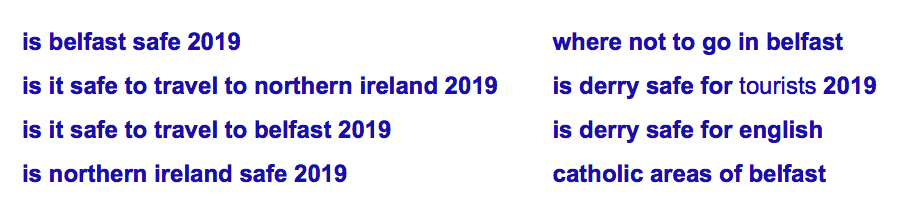
I’ve been thinking about the creative scene in Northern Ireland. Although we do have a number of ‘greats’ from over the years, and even the likes of JW Anderson emerging in recent years, I can’t help but feel as though we’re still lightyears behind our neighbouring countries. I think it’s safe to say that this could be tied into the Troubles, as during those decades, our tourism dropped to almost nothing. I mean, a country at war with itself isn’t exactly an ideal holiday destination, is it? Funnily enough, when I was searching things such as, “tourism and the Troubles” to try and find some evidence of this, these were the most common searches recommended to me. It came as a bit of a shock that even to this day, N.I. still has such a bad rep for travellers.
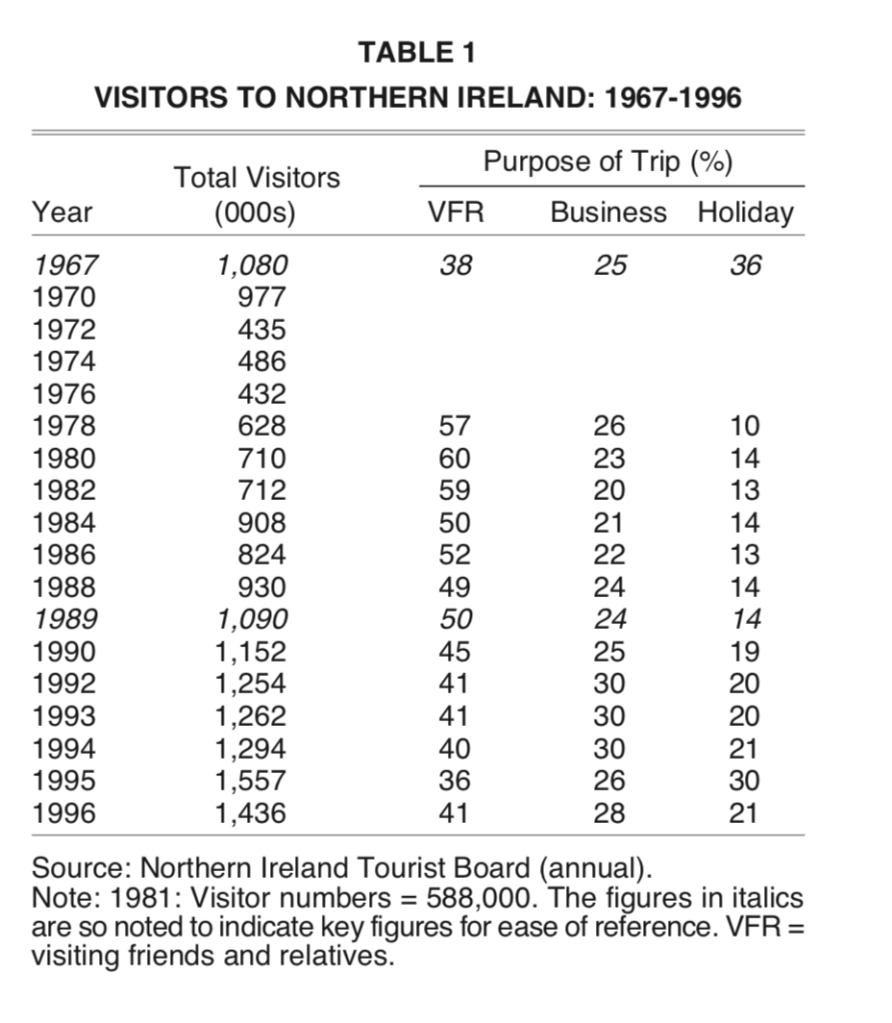
Below are some stats taken from a study that show the swift decline in tourism during the Troubles:
Of course, the reason I’m suggesting the lack of tourism is linked to our slow paced creative industry, is because without the influence of different cultures, people of different ethnicities and backgrounds, and those with a more open-minded attitude towards life and therefore art, how were we meant to progress? It surely affected all forms of expression, from music to literature, fine art to fashion..? Perhaps an influx of these kinds of people, either as visitors or those who may have decided to find a home in N.I., may have helped our ‘fear of outsiders’ we clearly developed over the years. As I’ve said, how can kids grow up to accept those different to them if all they know are their own kind? Perhaps that has not only been the case for Catholics and Protestants, but also for those of a different skin colour, or of a different sexuality? “Also threatened are the positive benefits of ethnic pluralism: in particular, its contribution of cultural pluralism to music, literature, fine art, and overall variety of life. When ethnic diversity is allowed to flourish, it enriches the human condition.” (Darby, J (1997) Scorpions in a Bottle: Conflicting Cultures in Northern Ireland. Pg 16. London, Minority Rights Publication.) Enough research has been done on the effects of living solely with ones own kind to know that it’s just not ideal by any means.
I really struggled to find online research to do with the Troubles and how it impacted tourism, because every link that surfaces was related to what people are calling ‘dark tourism.’ The name relates to the infatuation tourists nowadays have with our horrific past. Those from near and far are flocking to see Troubles Tourism. Murals of a political nature, even something as simple as a handkerchief, they love the morbidity of it all. The debate is simply put, it this a positive thing as N.I. is turning a conflict into profit? Or is it completely immoral because of the nature of it?
“Another tourism initiative funded under the auspices of conflict tourism was launched in May 2004.17 Billed as ‘a tourism initiative with a twist’, Belfast Safaris is a ‘pioneering’ new tourist programme aimed at promoting ‘alternative Northern Irish histories and heritages’.18 Using the increasing trend of providing a ‘real’ history, its objective is to bring visitors to North Belfast through the various neighbourhoods, ‘interacting’ with local people as they go: ‘Visitors have a huge appetite for the “real” Belfast. They’ve seen negative images on their TV screens for 30 years, and now they want to see the real thing.’19 The project was adopted from similar schemes tried in New York, Auckland, Prague, Berlin and Cape Town. Yet the word ‘Safari’ has undesirable connotations. Again playing on the notion of Belfast as a somewhat dangerous destination, the idea of taking tourists on an expedition feeds the tourism industry. Tourists engage with local residents who have experienced the Troubles firsthand, again using personal representations of memory to communicate conflict heritage. Project manager Marian Dalton argues:
The Troubles were a very dark time for Northern Ireland. But it happened, and its over, and we would like to take that negative perception and turn it round on itself, to try and create something positive for people. There may be visitors who are curious about how people in the area coped during the conflict, and hopefully there will be locals who are comfortable to talk about it to tourists, as honestly as possible, and in an objective way.20
These tours are funded because they are supposed to assist conflict transformation in Belfast. Yet rather than contributing to this goal, it can be argued that they are instrumental in sanctifying divisive, sectarian landscapes in which the debate over the authors of the conflict is all important and all consuming. The objectivity sought by Belfast Safaris clearly cannot be achieved in the arena of tourism as residents share one story, a story that is partisan and selective. In Ardoyne, the conflict is ever-present as residents clash persistently with the neighbouring Protestant community in Glenbryn. By concentrating on the injustices inflicted upon the local community by the state throughout the Troubles, commemorative icons within Ardoyne are designed primarily to reinforce the ‘us against them’ mentality that has not ended with the ceasefires. Tourists, in this instance, are invited into the neighbourhood in order to see representations of that injustice.” Sara McDowell (2008) Selling Conflict Heritage through Tourism in Peacetime Northern Ireland: Transforming Conflict or Exacerbating Difference?, International Journal of Heritage Studies, 14:5, 405-421, DOI: 10.1080/13527250802284859 ( http://dx.doi.org/10.1080/13527250802284859 )
I find this extract from a study on the Troubles tourism very interesting. Personally, I think it’s unavoidable that some will try their hand at making a profit from the country’s past. Personally, I think with everything that is still going on, with fighting between opposing political parties, people being shot in the streets and the odd riot breaking out, we should perhaps be putting our efforts into educating our own people, rather than entertaining those from outside it. I wonder if Catholics and Protestants will ever learn to accept half of the blame and move on, and 99% of the time I seriously doubt it. In saying that, maybe it’s best not to do things such as light up the murals at night for all to see, like pouring salt on a (whether you see it or not) still very open wound. I still firmly believe we must not completely forget in order to not allow history to repeat itself, but I think there’s a way to go about it, and a time to do it.
Sources:
 time to change