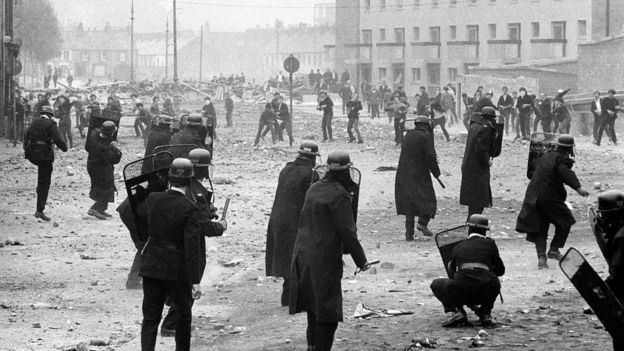
I was talking to my Dad about my work and he recommended a BBC documentary for me to watch about ‘The Battle of the Bogside” which tells the story of the first major conflict that many say was the start of the Troubles. These are my notes/a summary of the documentary:
Summary: August 1969; The Catholic population of the Bogside (Derry) took to the streets to confront a Protestant parade. British troops were sent to Derry because the violence was so awful. It started the 30 year conflict.
Northern Ireland had been ruled by a separate Unionist (Protestant) government since 1921. Though Nationalists (Catholic) were a majority in Derry, Unionists manipulated the electoral system to secure power in local government and retain control of housing and jobs. Nationalists blamed them for the poverty and overcrowding in Catholic districts.
In 1968, people started to take to the streets to demand equality. It wasn’t for a United Ireland, but to ‘become full British citizens, it was basically a civil rights movement. Some feel that although it was a breach of the order in N.I., the violence from the police they faced in return was unnecessary. On the other hand, the working class Protestants felt that the Catholics claim that Protestants were denying them certain rights was unfair as they themselves didn’t have them.
January 1969 saw a student led civil rights group set out on a march from Belfast to Derry. Protestants saw it as an attack on the Northern Irish state as a whole. At various points on the route they came under attack by Loyalists, and the worst of the violence came at Burntollet Bridge. News spread of the attack, and as they arrived in Derry, rioting started. In early hours of the morning on January 5th, R.U.C men started attacking houses in the Bogside. Barricades were put up to try to keep the R.U.C out. This is where the iconic phrase, “You are now entering Free Derry” came from as it was painting onto a wall at the barricades, which stayed up for 5 days, at the entrance to the Bogside.
Rioting against the police continued in an attempt to keep the R.U.C out of the area. On 19th April, a local resident of the area Sammy Devenny was beaten brutally in his home by a group of policemen. His daughter spoke out on national television, and on 17th July, he died, and the Bogside believed his death was due to his beating. Many consider him to be the first victim of the Troubles.
In 1969, The Apprentice Boys parade, an important event on the Protestant’s calendar, was predicted to induce violence. Many believed some Apprentice Boys were going to attack the Bogside during the march. The Citizens Defence Association was created, and tried to stop the march by meeting with the Apprentice Boys, with no luck. They also tried to get it banned, however banning such a big event was seen as too big of a risk, incase it caused an uproar in the Protestant community, so the N.I. government chose not to, and Westminster chose not to interfere. (Perhaps another sign to back up my point that the rest of the UK must get involved to prevent more violence.)
The Prime Minister met in London to discuss deploying the British troops, but were told they wouldn’t be allowed to control the troops on their own. On the morning of 12th August, the Apprentice Boys arrived along with the R.U.C. who were hoping to stop the violence. From William Street (Bogside), stones started to be thrown at the police, which were eventually met in return by the police. Soon there was a wall of young people from the Bogside facing a wall of police, who held up for a couple of hours, before turning to vehicles and charging towards and into the Bogside. A number of Loyalists attending the parade joined in on the violence so instead of a few police VS a gang of young Nationalists, there were hundreds involved. A headquarter of the Citizens Defence was quick established inside the Bogside, and the battle commenced. Petrol was bought to make petrol bombs and taken to the frontline. The R.U.C then became the first police force in the UK to use CS (like tear) gas on a civilian population. It was pumped into the Bogside, causing respiratory problem for the Nationalists.
The next morning, a group of young Bogsiders took a stand on top of a building of flats to throw stones and petrol bombs at the police from above.
People started moving out of the Bogside to safety, across the Irish border etc. This cause the PM of the Republic of Ireland to broadcast saying they couldn’t stand idly by, and that the R.U.C were no longer accepted as an impartial police force. This fuelled the concerns of the Unionist community, as most Nationalists assumed he was going to send troops to help defend the Bogside. In actual fact, he just set up first aid tents near the border in places like Donegal.
Rumours that St Eugene’s Cathedral was under attack. Although not directly targeted, it was enough to bring the doctors, lawyers and those who had not yet come out to fight, out of the woodworks to defend the Cathedral. The R.U.C. shot into the crowds injuring a small number of people.
After 24 hours, the police grew tired and hungry, many of whom hadn’t been relieved to eat or sleep, and Westminster drew concerned until finally the Northern Irish government accepted their terms and the on 14th August 1969, first officially deployed troops were sent in, but just to relieve the police and not to enter the Bogside nor confront the rioters.
The rioting stopped as the army arrived, and most Nationalists welcomed the troops and took the police being pushed out as a victory. They accepted the army’s presence, for now least. The barricades were kept as Derry and Northern Ireland waited for the wider response to as it’s now known ‘The Battle of the Bogside.’
It’s hard to say what my personal opinion is of this event, as I’d need to look into both sides further as I obviously wasn’t there, and it’s a very hard topic to get an unbiased opinion on. I think, as per most events like these throughout the conflict, both sides made mistakes. Part of my sympathises with the way the Catholic population were living, with regards to their housing and job opportunities, but I understand that when met with violence the police have to respond, and they were only following orders. Perhaps it’s more so the blame of those further up the chain of command. However, as I’ve said, it’s not as important who’s to blame, but more so how we can learn from this moving forward. It’s reaffirmed my view that both Catholic and Protestant people need to make a real effort to empathise and understand the concerns and struggles of the other side, if we’re to create a better and less polarised community. I also think it’s a good example of sometimes help from the outside is much needed. I suppose I think of it in a sense that if two kids are fighting, they’re unlikely to talk through the argument and find a solution without an adults guidance and supervision. So perhaps we need those of us who are completely unbiased, or those from other places in the UK or further, to be the ones to take charge of the discussion and lead it. Perhaps we can’t expect people to sort out their differences themselves. That again, is why I feel like projects like mine, and movements that raise awareness etc are so important.
I’m finding learning about all of this history very interesting and I feel as though I’m not only beginning to understand the country’s history better, but also the mindset of those who live in it. I think it’s important for me to start looking at visual inspiration and research so I can begin applying some of my ideas not only to my essay but to my practical work too.
 time to change